





Solar panels: mortgage & tax
With current energy prices, installing solar panels on your home has become even more attractive. But can you finance solar panels through your mortgage, and how does VAT work? This page explains everything you need to know.
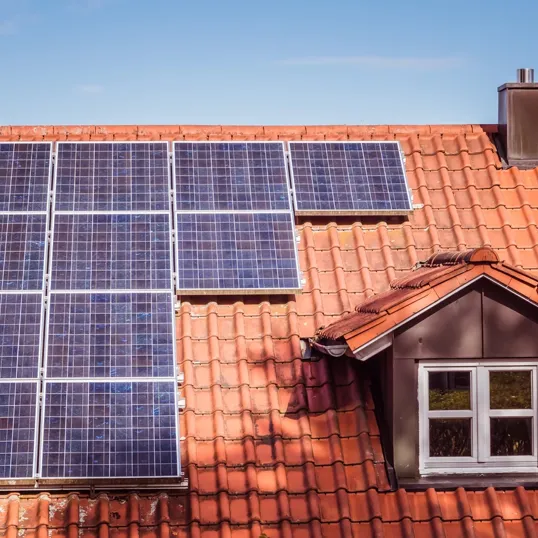
Solar panels are a smart investment for your home. They generate your own electricity, saving you hundreds of euros each year. Your monthly energy costs decrease, and you can reclaim the VAT paid on the installation of the solar panels from the tax office. As a result, you often recover the full investment within about seven years. If you do not have enough savings to buy solar panels, you may be able to increase your existing mortgage.
Increasing your mortgage for solar panels
Would you like to finance solar panels through your mortgage? In many cases, this is possible. If you inform your mortgage provider that you want to increase your mortgage for solar panels, they often approve it. After all, your monthly expenses immediately decrease due to lower energy costs — freeing up money to cover the slightly higher mortgage payments.
However, there are limits. Your total mortgage cannot exceed 106 per cent of your home's value, and an income assessment is also required. To understand what this means for your situation, always consult your mortgage advisor.
What counts as energy-saving measures for your mortgage?
Solar panels are considered energy-saving measures for your mortgage. If you are buying a home and plan to make it more sustainable — for example, by financing solar panels through your mortgage — you can borrow more than usual. In 2026, you can borrow up to 106 per cent of your home’s value (instead of the standard 100 per cent) when funding energy-efficient upgrades.
Do solar panels increase your home's value?
Do solar panels raise your home's value? In most cases, yes. While it depends on factors like the number of panels and their quality, installing solar panels usually boosts your property's appeal to future buyers.
Solar panels can improve your home’s energy label and significantly lower monthly energy bills. Plus, buyers may qualify for a larger mortgage when purchasing an energy-efficient home.
Costs and savings of solar panels
You only have to pay the costs for solar panels once, but you get yearly savings from it. After all, you won't have to buy the kilowatt-hours (kWh) from an energy company that you generate yourself. Any energy you don't use straight away is supplied to the grid. At the moment you can offset the energy you generate against the electricity you draw from the grid. This is called net metering and you can do this until the end of 2026.
The net metering scheme will end in 2027. That is why we calculate your annual savings in 2026 (with net metering) and in 2027 (without net metering). The table below shows your savings based on 30 per cent self-consumption of the solar power you generate. This is the average energy consumption of a household.
| Number of solar panels | Costs (ex. VAT) | Annual savings in 2026 | Annual savings per 2027 (end of 'net metering scheme') |
| 6 | € 3,100 | € 410 | €150 |
| 10 | € 4,500 | € 500 | €170 |
| 18 | € 7,000 | € 800 | €230 |
The exact return on your solar panels depends on your situation and on factors such as purchase costs, electricity prices, feed-in tariffs, and feed-in costs. The biggest influence on your return is how much solar power you use: the more you use, the more cost-effective it is.
VAT Exemption for Solar Panels
As of 1 January 2023, private individuals no longer pay VAT on solar panels installed on their homes. The 0% rate applies to both the supply and installation of solar panels on or near a residence — including garages, sheds, extensions, conservatories, and even holiday homes.
The 0% rate also covers additional costs like cable installation, mounting materials, optimisers, inverters, and any necessary adjustments to your meter cupboard due to the installation.
However, other work, such as reinforcing your roof, is still subject to the 21 per cent VAT rate.
Claiming VAT on solar panels
Since the VAT rate is now 0%, there is no need to reclaim VAT from the tax office. However, the tax office still considers you a VAT entrepreneur, as you supply energy back to your energy provider.
For most private individuals, if your annual revenue is below €1,800 and your solar panels' capacity is under 10,000 Watt peak, you do not need to register as a VAT entrepreneur.
The information on this page has been verified by:
